
AI sexing
Non-invasive wing-tip analysis with three output lines: male, female and return. When the reading is inconclusive the chick goes back for a new analysis instead of forcing a wrong decision.

Sexing, vaccination, counting and grading — decision and execution in the same machine, inside the hatchery line.
Sexing, vaccination, counting, boxing and grading all happen in the same place, usually with equipment from different suppliers, each with its own warranty, technician and contract.
A hatchery manager does not want six machines from six suppliers. They want an automated line, one supplier and one warranty — with data running end to end.
The badge shows the stage of each module. Confirm with our team what is available for your operation.
Non-invasive wing-tip analysis with three output lines: male, female and return. When the reading is inconclusive the chick goes back for a new analysis instead of forcing a wrong decision.
Standardised application that does not depend on operator pace or fatigue, with every dose recorded for batch traceability.
Individual counting and physical sorting into boxes, with the count per box closed and recorded — no manual check at the end of the line.
Grading by quality criteria defined by the hatchery, with physical output separated by class.
Individual sexing, decision and physical sorting happening at production speed. This is the difference between a system that points and one that acts.
The confidence threshold is configurable. Hatcheries that prioritise volume tune for throughput; operations that prioritise accuracy tighten the criterion and widen the return line. The same machine serves both scenarios.
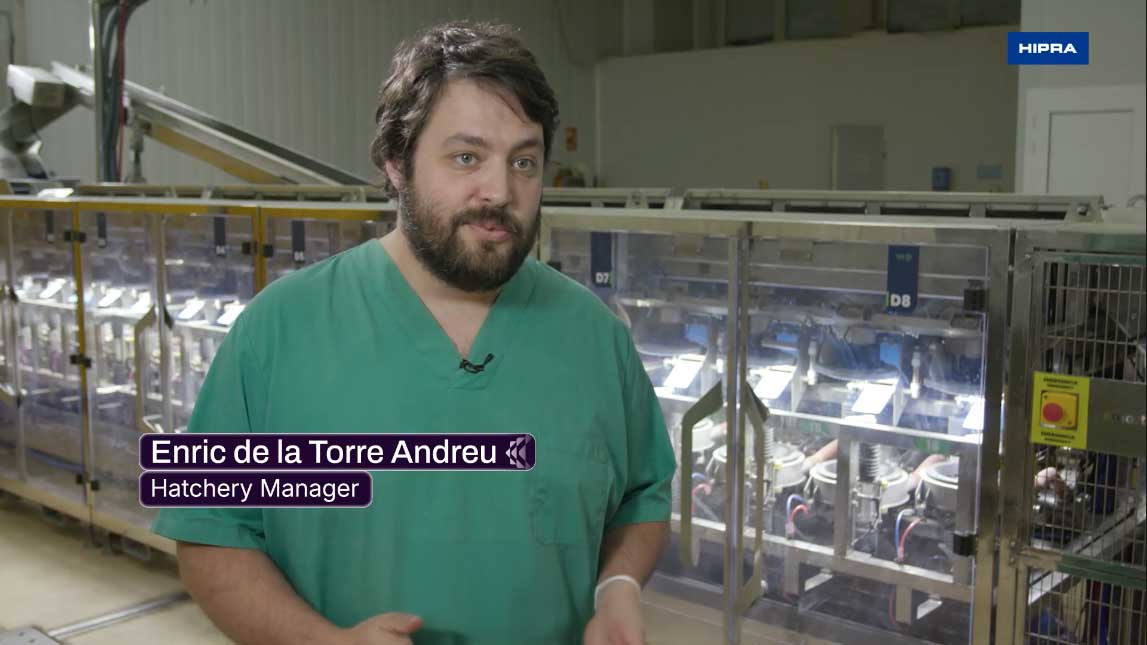 equipment in operation · real installation
HIPRA is the international distributor of HatchFlex outside Brazil, bringing Smartpixel technology to hatcheries in markets around the world.
Go to hatchflex.com ↗Consistency. The reading does not depend on fatigue, shift or operator experience, and every decision is logged — which gives the hatchery traceability and a usable dataset.
Because image quality determines model accuracy. With the bird at rest, the image is clean and comparable across batches; with capture in motion, blur introduces error that no model recovers from.
It does not guess. Below the configured confidence threshold, the bird goes to the return line and is re-analysed — protecting accuracy and throughput at the same time.
The analysis is non-invasive, based on a wing-tip image, with minimal handling and controlled dwell time.
AI sexing runs in the first Brazilian hatchery to operate the process without manual intervention, and the technology is also installed in hatcheries in Europe. Press coverage and testimonials are on the home page.
Tell us the bottleneck — sexing, vaccination, counting or grading. We assess technical feasibility and come back with a concrete path. In territories served by our international distributor, we route you to the right channel.